BURKE DOEREN TALKS GRIZZLY NIGHT
"I wanted to honor the real events"
 Daniel John
What got you started in filmmaking and bringing scenes to life on screen. How did you first start seeing things in frame?
Like almost all great passions, I started making VHS movies and taking film photos as a kid. My dad had a Leica AFC-1, the brand’s first autofocus point and shoot-35mm film camera, and with that camera we captured thousands of photos. He taught me about composition, timing a moment, and the basics of visual design storytelling, one frame at a time. My dog, Legos, and friends became the stars of my very early movies and photos. Both of my parents helped me save for Mini-DV cameras and an editing computer in middle school which is when I first learned the Adobe creative suite. Later, my high school had a fantastic Film and TV program called KSMS where we were lucky enough to shoot with HD digital cameras, groundbreaking in 2007, and edit with Final Cut. My teacher Travis Gatewood taught me so much about editing and storytelling, and that class was really where I gained enough confidence to pursue filmmaking in college at Chapman University and ultimately as a career, my time at Chapman University was where I finally got to experiment with real film equipment on true soundstages and met so many amazing friends whom I still work with and see today. In fact we had nine Chapman Alumni on 'Grizzly Night'. Including our core producing team, Tyson Call, Lauren Call, Kellie Doeren, myself and our line producer, Chelsea Fenton.
'Grizzly Night' is based on the true events that's known as the night of the grizzlies, an August night in 1967 where several unrelated grizzly attacks took place in the same national park. What got you to want to re-visit this terrifying night on screen?
The message of the importance of respecting nature and wildlife is absolutely what drew me to want to tell this story as a film. We want viewers to understand that this was a pivotal moment for how national parks handled grizzly bear interactions. But I hope that our audience can relate to this for all levels of wildlife and nature preservation. We only have one planet, and we need to respect it and the animals who inhabit it with us. As our film so carefully demonstrates, tampering with nature can lead to innocent lives being lost. And in terms of the script, I reached out to my friend Katie Mathewson, a highly talented screenwriter and another Chapman Alum, in January 2022 after her new series 'Hawkeye' had premiered on Disney Plus. She and her writing partner, Tanner Bean, already had a draft of this script penned, and once our producing team read it, we wanted to see if we could make it happen. The first step was to determine if we could find a real trained grizzly bear and a real location to be able to support the scenes in this film. After an extensive search, we found both!
You worked with a real grizzly bear on it?
Yes we did! His name is Tag, and his trainers Keith, Steve, and Titus work with Gentle Jungle. Their company is based north of LA and has worked in the film industry for decades, providing animals for movies like 'Gladiator', and tons of other large scale films, series and commercials. Tag was on set for roughly a week, and working with his trainers felt like making a flight plan with pilots. They were focused, direct, and helped us map out all of the ways that Tag could interact with props and the environment on set to make his scenes feel as realistic and visceral as possible. We also worked with our post house, DigitalFilm Tree on Pre-Vis that helped us map out the grizzly attack scenes. This was especially important for our shot list and camera team to determine how to cover the scenes with our cast and Tag in the safest way possible. Also, almost all of this film is presented as it was shot through the lens. The only VFX in the entire film are some wire removal from scenes with Tag acting in it, the wires help him know where to stay, some additional fire VFX elements in the buckets and distant aerials. And some day for night conversions with additional stars. Our film was authentically human made, and that’s my favorite way to make movies.
Many directors would have seen this as an opportunity for a more “fantastical” creature feature. But you rather ground it in a serious and authentic way, making clear that this event is terrifying in its own right?
Because this is based on a true story, I really wanted to tell the story in a way that honored the real events and respected the tragedy of the situation. That led us to focus on the human elements of the story, focusing on our characters during bear attack scenes rather than gore, because I really wanted to show what it must have been like during those moments in a deeply emotional way. Our cast really did such a phenomenal job with so many heavy and challenging moments. I also really wanted this story to resolve in a balanced way that reminds you that the bears were victims in this tragedy, as well. And I believe we landed those final moments of the film in a memorable way.
There’s also something about how you capture the terrain, that raw stillness of what’s it like in nature, which just makes the moment of frenetic panic when violence occurs even louder. Translating stillness into intensity on film can be like holding a camera to the sky trying to capture the warmth of the sun though. How did you find a way to do that?
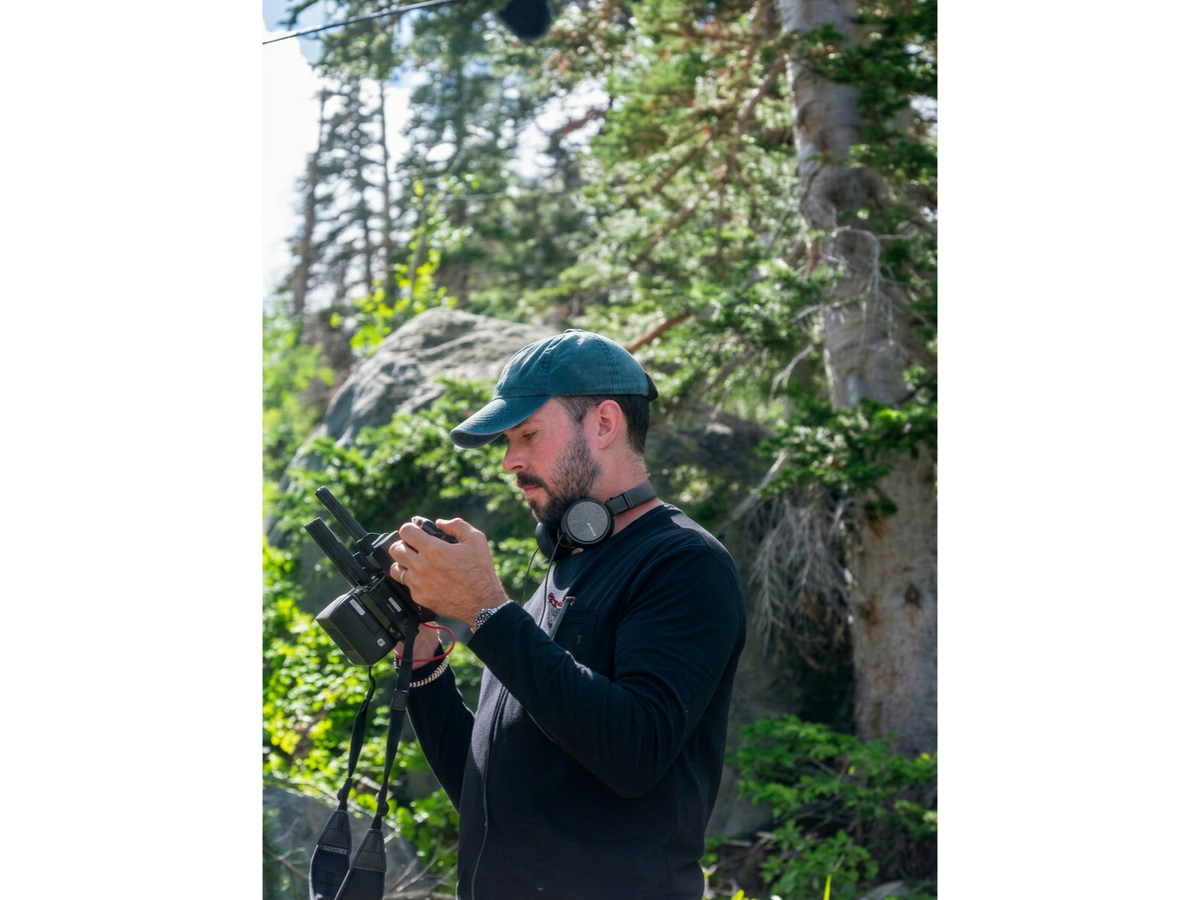
Collaborating with my DP team was such a joy. I’ve been working with Brian Mitchell and Ian Start for ten years now and they both spent weeks planning out the shot list with me. Brian joined for production, Ian was on his honeymoon, and we put a lot of effort into determining how the camera should move for every shot. We filmed on two Alexa 35 cameras with Cooke Panchro Classic lenses, and the result feels so beautiful and deeply vibrant. We also spent three days capturing vistas and texture shots in the real Glacier National Park. So, if you have visited the park before, you’ll see a lot of familiar views throughout the film. Being at the park in person felt like stepping back in time. Nature is truly verdant and untouched and there isn’t even any cell phone signal once you are a few miles into the park. It’s beautiful and I’m thankful that we were able to visit, tread lightly, and capture those moments. Lastly, our aerial DP, Jon Riley, was pivotal in capturing aerial scenery and the air-to-air coverage of Ranger Bunney’s blue helicopter in the film. Jon is an absolute wizard with controlling his gimbal system while flying in a helicopter. And his collaboration with our two pilots really made for some wonderful shots. Our EP Tyson and I joined Jon for the helicopter production day, and that was something we have wanted to do since film school at Chapman.
You founded your production company, 22 Waves, with your wife and creative partner, Kellie, whom you met while attending film school, and as you mention you continue to work with friends from school. People often debate the academic route within creative paths, would you say creative kinship at least is one good thing to get out of it?
Attending film school at Chapman University was definitely the best way for me to start my career. I made so many good and talented friends through Chapman, and I still work with them constantly. On this film alone, we had nine Chapman Alumni, and I keep in touch with professors at the university whenever we need referrals for new crew positions. And yes, Kellie, Tyson, Lauren and I all met while we were at Chapman and we’ve all worked together a ton over the years since then. It was our dream to be able to make a feature film together since school. And I’m so glad we were finally able to do so. Choosing Film and TV as a career path is not an easy choice, it takes constant dedication, passion, persistence and teamwork. 'Grizzly Night' has been a four year process so far since we first read the initial draft, and it has been an absolute journey to take it from a script all the way to the international screen. So, in summary, I think attending film school is a fantastic way to start your career and meet people who are equally as dedicated as you are.
After previously working on mostly branded and commercial projects for different brands, or high-profile celebrities like Kourtney Kardashian, how different was it to direct a feature film?
All filmmaking is teamwork, no matter how big or small the project is. This feature was an indie, but it felt like stepping up to the major leagues. We had about hundred crew members and thirty-five-plus cast members working on the film on any given production day, so there were quite a lot of people dedicating their time and expertise to help tell this story in the best way possible. We had twenty-two production days, filming entirely on real locations in Utah and Montana, and it really felt like such a dream situation to be able to capture our first film in such an authentic way. We had a real bear, real locations, filmed in the real Glacier National Park for establishing vistas, had an aerial air-to-air helicopter day, and such a talented cast and crew. My favorite part of this past four year experience was production itself. It’s energizing to be on set filming moments where everyone is trying their hardest to tell a story. And for me, my main goal was to be decisive, adaptive to real world changes like scheduling and weather, collaborative and focus on the feeling of every shot. It was an exercise in delegating, and I’m honored to have worked with so many experts on this film that it really ran quite smoothly, despite the overall complexity of production. Post-production was also fantastic, as we aimed for high technical standards with a 4K Dolby Vision HDR-output, with Dolby 5.1 surround sound. Our post house DigitalFilm Tree and audio engineers, MobileSessions, both worked their magic to bring the film together and make it feel as polished as it does.
Does this film reflect the direction you see yourself heading in, on the narrative side of filmmaking?
Absolutely! I’ve always loved historical thrillers with deeper messages and I am thankful that I was able to start my feature filmmaking career with a story like this. I’m currently exploring a few different options for our next feature. Luckily we have a talented group of friends, so I’m excited for the opportunity to work with them again on more films in the future.