JAZZ EGGER TALKS MAIN CHARACTER //001
"To look at your life almost like a story"
 Daniel John
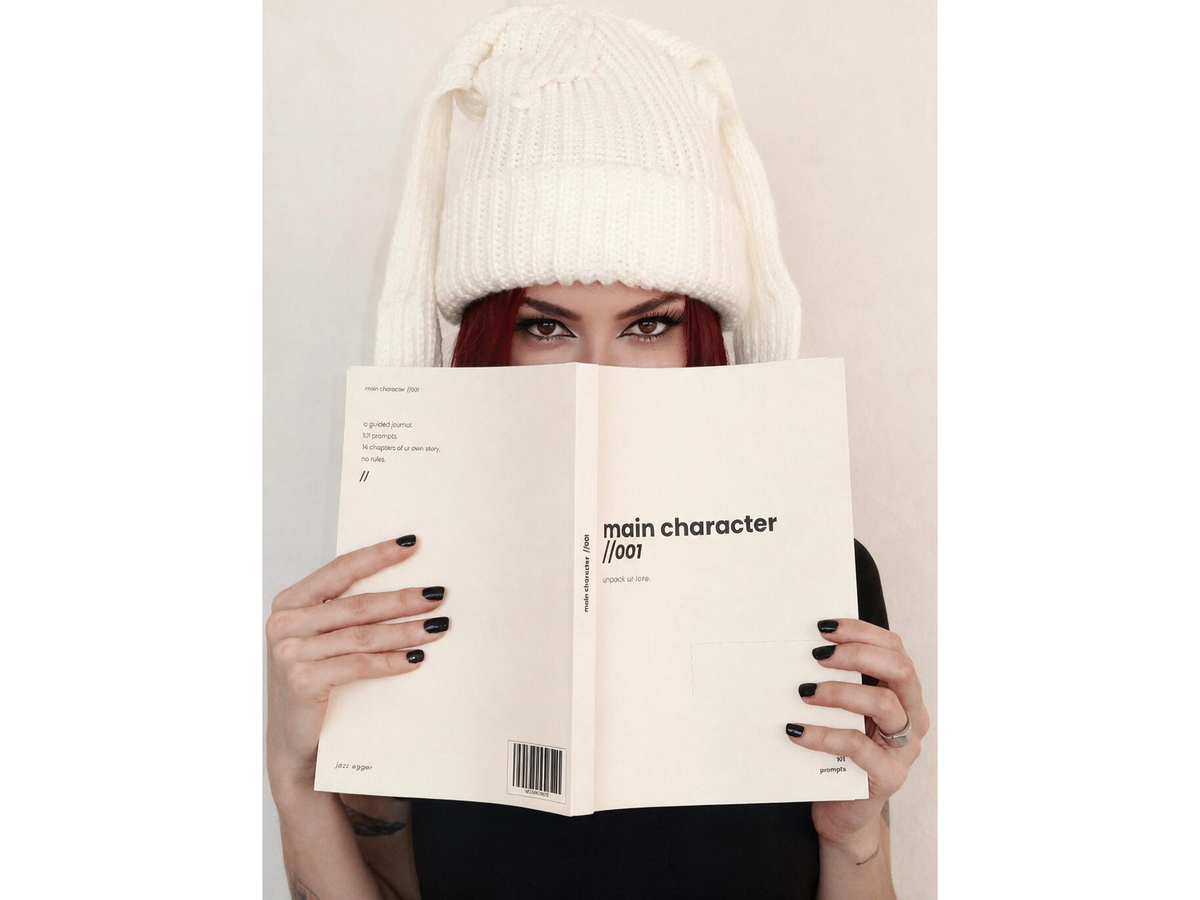
'main character //001: unpack your lore' is a guided journal about approaching life a bit more cinematically. What prompted you to create this, what is the philosophy behind it?
I’ve always struggled with actually staying consistent with journaling. I’d buy a beautiful notebook, write in it for three days, and then somehow never touch it again. I also used to shrug it off when people told me to take journaling seriously. I thought it was one of those things that sounded nice but wasn’t really necessary. Then I realized how much writing things down was actually helping me. Journaling genuinely became one of the things that got me through some of the lowest points in my life, after God, and I really can’t stress enough how life-changing it can be. So I started thinking about what kind of journal I would actually want to use. I didn’t want affirmations or a bunch of rules. I wanted questions that made me stop and actually think about my life, followed by enough space to really answer them. The cinematic idea came from wanting to look at your life almost like a story. Not because life needs to be dramatic, but because sometimes looking at your memories, relationships, plot twists, mistakes and different versions of yourself from that perspective helps you understand them differently. The journal has 101 prompts across fourteen chapters, from “origin story” and “deleted scenes” to “plot twists”, “side quests” and “after credits.”
Is seeing your life as a film something you have used, to look at the plot twists and character development of your own life, as a way of directing your story toward where you want to be?
Definitely. I think I naturally process my life through stories anyway. Working in acting, producing and casting has probably made that even stronger because I’m constantly thinking about characters, motivations, scenes and what makes a moment meaningful. Looking at my own life that way helps me step outside of it for a second. You can look at something that felt like the end of the world at the time and realize it was actually a plot twist, or look back at a version of yourself and understand why she made the decisions she did. I also think the idea of “character development” is important because you’re never really finished becoming who you are. There are things I’m still unlearning. Boundaries I’ve learned to hold and things I’m still working on. Those are literally some of the prompts in the character development chapter. And especially creatively, I’ve had a lot of moments where I had to make decisions without knowing exactly where they would lead. Sometimes you just have to take the side-quest and see what happens.
What act of your film do you feel you’re currently living through?
Probably the part where the main character stops waiting for permission. I feel like I’m in a really self-directed chapter of my life right now. I’m still figuring things out, but I’m much more comfortable creating things because I want them to exist rather than waiting for someone else to tell me that I’m allowed to do them. That’s actually a big part of what this journal represents for me. I made it because I wanted it to exist, and now it does. I think I’m in a chapter of taking the ideas that have been floating around in my head and actually doing something with them.
Journaling sounds like it could encourage overthinking things but isn’t there something about the act of writing things down, of putting thoughts into words, that can actually create a distance that frees up a lot of mental space?
A hundred percent. I think there is a huge difference between thinking about something and actually putting it somewhere. When something stays in your head, it can become this giant, tangled thing because you’re experiencing the thought and reacting to it at the same time. The second you write it down, you can actually look at it. Sometimes you realize it’s not as big as you thought it was. Sometimes you realize it’s much deeper than you thought. Either way, you’re no longer just carrying it around. That’s probably the biggest philosophy behind the journal. It’s not about finding the perfect answer to every question. Sometimes you just need somewhere to put the thought. There’s a prompt in the “open tabs” chapter that simply starts with “I still think about...” and another that asks “what keeps me up at night...”. That’s exactly the kind of thing I mean. You’re taking something that’s been looping in your head and finally giving it a place to exist outside of your head. And I think also my songwriting does something very similar for me. You take something internal and turn it into something tangible.
You’ve called this 'main character //001', suggesting there will be more editions to the series. Already leaving the reader's story in their own hands, what do you want to help them uncover in the next volumes?
I definitely want it to become a series, and I think each volume can explore a different part of your story. For the first one, I wanted to focus heavily on looking back, where you came from, the people and experiences that shaped you, the things you never said, the memories you still carry and the versions of yourself you’ve left behind. Then by the end, you’re looking forward again. The final chapter is literally called “after credits,” because the story isn’t over. For future volumes, I’d love to go deeper into things that maybe don’t fit into the first book. More specific parts of identity, relationships, ambition, love, loss, creativity, the future, and the person you’re becoming. But I think the most important thing is keeping the reader’s story at the center. I don’t want to tell people who they are. I want to give them the questions that make them figure it out themselves.
Before LA, just being an Austrian girl, what were the earliest traces of creativity and having something to say?
I think I’ve always had a very active inner world. Even as a kid, I was constantly making up stories, characters, little scenarios and different versions of how things could be. I was very observant too. I would notice people, dynamics, little details and then create entire stories around them in my head. I think that was probably the earliest version of what I do now. I’ve always been interested in people and why they behave the way they do. I just didn’t have the language for it back then. Growing up in Austria also gave me a slightly different perspective. It’s a small place, and I always had this feeling that there was a much bigger world outside of it that I wanted to experience.
You started modeling at fourteen, by fifteen already working internationally. How did you end up at your first castings, giving your first looks to the camera?
I was scouted on Facebook and invited to attend Elite Model Look, the most prestigious modeling contest in the world and ended up making it to the finals which resulted in an international agency deal. I was fourteen and busy skateboarding and listening to emo rock, so modeling wasn't exactly on my agenda. I realized it was a huge opportunity to take a look behind the scenes though and gave it a shot. I never agreed with the dark sides of the fashion industry so I kind of made it my mission to shed light on those hidden aspects, which I did. I published several articles and went viral for exposing the less glamorous sides of modeling. The first few were definitely surreal. You're so young and suddenly adults are telling you where to stand, how to move, what expression to make, what to change about your appearance. I also think being thrown into that environment so young made me comfortable with uncertainty. You go to a casting, you give it everything, and then you leave and have absolutely no control over what happens next. You learn not to take every yes or no personally. But it did mess with my self-perception for years. Casting directors and makeup artists pointing out flaws about your looks you were not even aware of definitely leaves marks when you're a teenager.
With everything you’ve done it is hard not to see your career as clearly successful, but would you say your career as a model was hurt by being outspoken and not just playing along?
Yes, for sure. I think it would be naive to say that being outspoken never comes with consequences. I have lost deals and agency contracts due to me exposing truths. There are definitely situations where being agreeable or saying what people want to hear would make your life easier. I've certainly lost opportunities because I wasn't willing to do that. But I also don't think you can build a life around constantly calculating what version of yourself will be most acceptable to everyone else. At some point you have to decide what you're willing to compromise on and what you're not. I'd rather have a career that actually feels like mine than one that looks successful from the outside but doesn't feel like me.
Modeling soon also turned into acting, both fundamentally about representing someone else’s vision. Even though you had already written bangers for other artists before, you launched your own music project last year, as Jazz Moon. What has that meant for you in terms of being a more self-directed expression?
That has been a completely different feeling. Modeling and acting are inherently collaborative. You're stepping into somebody else's world and trying to understand their vision as deeply as possible. I love that part of it, but there's also something very freeing about creating something where the starting point is completely your own. With Jazz Moon, I don't have to wait for somebody to cast me, write something for me or decide that I'm the right person for their idea. I can just have an idea and turn it into something. I've written for other artists for a long time, so songwriting wasn't new to me. What was new, was putting my own voice, my own stories, and my own identity at the center of it.
Your latest song 'Motions' dropped in January. Are there more set in, well, motion for you musically this year?
Definitely. I'm still very much in the process of figuring out what Jazz Moon is going to become, and that's actually the part I enjoy. I don't want to rush it just because there's an expectation to constantly release something. I'd rather make things that actually feel like me and let the project develop naturally. There is definitely more music coming, though. I am really excited about the songs I've been working on and have a whole dream rock EP coming out soon.
Acting-wise you have a little role in Izabel Pakzad’s wild ride 'Find Your Friends', which premiered this summer. A party to die for as a besties’ night out spirals. How was that or any other recent or upcoming roles we can see you in next?
'Find Your Friends' was really fun because the whole project has such a specific energy. It's chaotic and funny and uncomfortable in exactly the way a really good night out can become when things start going completely off the rails. I loved being part of that world and getting to work with everyone involved. I'm also continuing to pursue acting and have a few things in development, but I'm pretty selective about what I want to talk about before things are officially announced. I think there's something nice about letting a project exist for a while before putting everything online. But I can say there are some horror movies in the works that I am really excited to be a part of. I’m also at a point where I want all the different things I do to feel connected rather than separate. Acting, music, writing, producing. They are all different forms of storytelling for me.
There's been a throughline though of authenticity in everything you do. Always real and truth-telling. Whether that at the core has been a love that could never break, or a will for the bad to never win, what's made it worth it?
Thank you, that's very kind. I think I've always had a pretty strong sense of what feels true to me, even when it would have been easier to just go along with something. Keeping going isn't always some huge, inspiring decision. Sometimes it's literally just waking up and deciding you're going to try again. I've had moments where I've questioned what I'm doing, where I've been exhausted, where things haven't worked out the way I wanted them to. But I think the things that are genuinely yours are worth fighting for. The people you love, the things you believe in, the work that feels meaningful to you. Those are the things that keep pulling you forward. And I think I've learned that you don't have to know exactly where you're going to keep moving. The biggest aspect that's helped me get back up though is God. All glory to God. If it wasn't for Him, I would not be walking among this earth anymore.